POE Question 3
As great as the advancements in technology are for us as people, there are some downsides. With awareness rising for mental health issues and the psychological impact they have; we are noticing an increase in the number of mental health problems that have a direct relation to the use of technology.
Perpetual Distraction: – this is an issue that many people have due to our constant attachment to our phones (OpenLearn, 2019), like Pavlov’s dog hearing the bell when we hear a beep or ding, we are looking for our phone. We are willing to forgo concentrating on the current task to see what other people are doing.
Disruption of the Work/Life balance: – before mobile phones were able to access the internet people could disassociate from work when at home (OpenLearn, 2019). But now with smartphones being online and people having their work e-mail’s on their phone it becomes harder to disengage from work.
Fear of Missing Out (F.O.M.O): – since we are always connected to social media, we can see what our friends are doing via their posts. If you did not know that a group of your friends were doing an activity but later find out from their posts, you feel left out (OpenLearn, 2019). Because we do not want to feel like our friends are not including us, we as social creatures look for any signs of being left out and try to be included.
Cyberchondria: – this term is similar to hypochondria, a condition where the affected person is excessively and unjustly worried that they have a serious illness. Cyberchondria refers to a person’s anxiety about their mental or physical health due to researching their symptoms online and finding the worst possible causes (GoodTherapy, 2017). An example is if you are having chronic headaches, a Google search may say this is a symptom of brain cancer.
Bibliography:
Good Therapy. 2017. Cyberchondria. [Online]. Available at: https://www.goodtherapy.org/blog/psychpedia/cyberchondria [Accessed 30 July 2020].
Open Learn. 2019. Stress and anxiety in the digital age: The dark side of technology. [Online]. Available at: https://www.open.edu/openlearn/health-sports-psychology/mental-health/managing-stress-and-anxiety-the-digital-age-the-dark-side-technology [Accessed 30 July 2020]
This is the link to my video:
Question 1
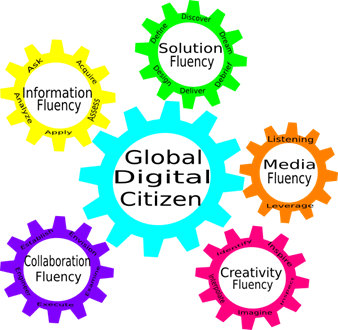
Unlike the generations before us we are in a position were what we learn today may become irrelevant within a few years or at worst a few months. More and more emphasis is being put on learning not only the core work of our modules but also learning skills that will help us adapt to this ever-changing world we find ourselves in. These are the five fluency skills identified by Crockett, Jukes and Churches. Below I will do my best to describe them and give examples to show how they are useful for our generation.
Solution Fluency

Three steps to problem solving by Gerd Altmann
The education system has taught us problem-solving in a “show-and-tell” manner (teachers show us the problem and tell us how to get the answer). This manner of teaching has fostered a culture of dependency in us, rather than one of discovery. But looking at today’s economy, you will discover that most low level or “menial” tasks have already been automated or outsourced via the Internet in a global economy, leaving jobs that require people with greater problem-solving skills. This means people are needing creative minds if they wish to be present in higher positions in our modern businesses.
Information Fluency

Procrastination by Timothy Hodgkinson
Because of InfoWhelm, the experience of feeling overwhelmed with too much information (Suzanne Vander Wekken 2013), the quantity of data is increasing at a dramatically fast rate, facts are becoming obsolete within months, and knowledge that is taught with these facts as their basis are less reliable. Information fluency is the ability to automatically interpret what is within this flood of information and be able to extract the essential bits and pieces and perceive their significance against the rest.
Creativity Fluency

Left right human brain concept by LisaAlisa_ill
Creativity fluency is the knowledge of how artistic proficiency adds to meaning through design, art, and storytelling. We as humans are all creative in some way. This means that this creativity, however you chose to express it, can be taught and understood like every other skill. It is a whole brain process that involves both hemispheres working together.
Media Fluency
In our current world of technology, communication with one another has gone far beyond just using text. Our visual learning capacity needs stimulation from a variety of different sources. But this is more than just using a camera, creating a podcast, or writing a document. There are two components of Media fluency, input and output.
An example of each is active listening for input, not just hearing what is being said but also taking that information, decoding it and processing it before you make your reaction.
For output we try to convey our message in the correct tone for the current audience, to give our message the best chance of being understood fully.
Collaboration Fluency
In many businesses around the world it is becoming more common place for people from different departments to start working together on any given project. It is this spirit of collaboration that businesses are trying to stimulate within their market, in our social networks, and in our ability to create products of value and substance. Collaboration fluency is the ability to successfully work and interact with virtual and real partners.
And so if everyone is able to active learn and practice these five fluencies we will see people being able to interact with one another on a greater scale and have a greater understanding between us all.
Question 2
Question 3
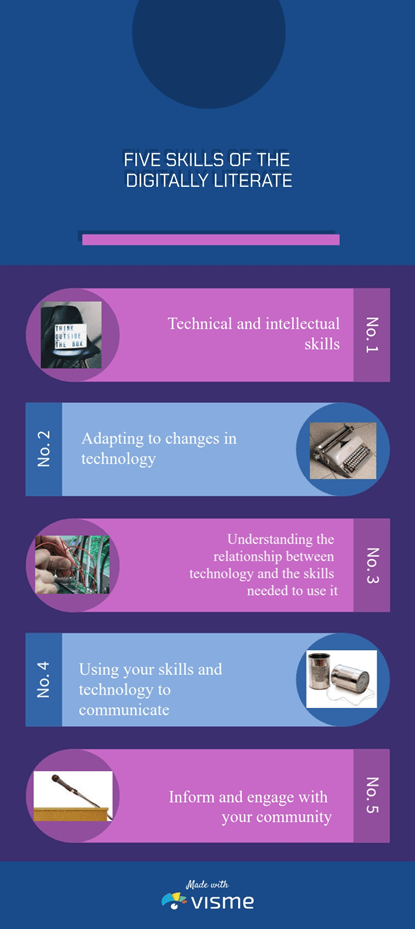
Due to the rapid advancements being made in technology we are finding new ways to communicate with one another and how companies are communicating with us. Below are five trends that have or are currently changing our ways of interacting.
Shifting From Hands-on to Hands-free
With advancements being made in artificial intelligence, voice recognition and hand tracking we are finding more people getting information from their devices by asking it directly rather than opening the phone, opening your browser and typing in your requests (Iliyana’s Blog, 2019). They assistants built into modern smartphones like Siri or Google assistant are the most well know examples of this new form of integration between people and their mobile phones.
Smart Houses
With products connecting to local networks in modern home we have seen a shift in how people are interacting with mundane objects such as the light switch and the thermostat (Iliyana’s Blog, 2019). By being connected to these local networks people are connecting devices like the Amazon Echo and Google Home to products like Nest Thermostats and Hue Lightbulbs and are now able to activate and control them by voice commands rather than using switches and control panels.
Interacting With A Human Is Now Optional
Chatbots are not a new development for people who have been on the internet for a few years but there has been a rise in the usage of this artificial intelligence software for communication between businesses and their customers (DMI Blog, 2020). Just a few years ago if you called a customer service center you would be talking to a person who would transfer you to the department you asked for. Now we are greeted by a prerecorded message that list every option available and each one may contain further sub-menus before you find the department that you wish to talk to.
Try Before You Buy Using Augmented and Virtual Reality
Augmented reality is technology that alters what you see from your camera through a piece of software “inserting” objects and altering the image (Digital Doughnut, 2018). Virtual reality needs you to wear headgear that has a screen close to your face and the video feed that is being displayed moves with the headset allowing you to look around a virtual space as if you were standing there yourself. Companies like Michael Kors ran an augmented reality advert that used your phones camera to show you wearing the sunglasses being sold giving you the experience you have when in a store of seeing how you look with them on.
The Increase in Influencer Marketing
Many brands have been paying influencers across all social media and video platforms to promote a product or service (eLab Communications, 2019). For people who make a living on YouTube by monetizing their videos this became a great opportunity in 2017 when the infamous ‘adpocalypse’ saw a mass wave of advertisers leaving the platform and many people losing their income as the videos that they worked on no longer would contain adverts. Then companies started approaching these influencers directly and offered to pay them for time during the video to be used as promotion of the product or service offered. An example is many VPN services are being promoted by influencers during this global pandemic and lockdown.
Question 4
As we are growing up our family and teachers educate us in the correct and socially acceptable way to interact with one another, this is learning about etiquette. While most people practice common etiquette when interacting face-to-face, many do not apply this to their online conversations. Below I will list a few examples of bad etiquette when interacting online.
Giving Little or No Context
When you make a post or are replying to one you need to give context to what you are saying since what you are writing may make sense to you but not everyone has the same way of thinking and many may not understand what points you are making without context (The Cybersmile Foundation, 2020).
TYPEING EVERY WORD WITH CAPITAL LETTERS
The proper use of capital letters make reading and comprehending what a person has written easier. If every word is fully capitalized it breaks the flow of the sentence since every word is being emphasized. Many people all see this as someone trying to shout using a keyboard (The Cybersmile Foundation, 2020).
Spam
When trying to interact with some or with a business online some people believe that sending the same message multiple times will improve their chance of getting attention. What is more likely to happen is that person or business blocking you and possibly getting banned from the site (The Cybersmile Foundation, 2020).
Posting Immediately
Some people want to give their thoughts and opinions as soon as they have written the message and do not check to see if what they have written has spelling errors or if auto-correct has changed a word. This type of mistake may change the meaning or intent of your message enough that you may offend someone you were trying to compliment (The Cybersmile Foundation, 2020).
Lying About Your Identity (Catfishing)
If you are interacting with people and building a relationship while lying about who you are, you run the risk of causing emotional and psychological harm to them when they find out about the lie.
Publishing Someone’s Private Information (DOXING)
By sharing another person’s private information without their consent, you may be endangering them, especially is you are sharing their home address.
Don’t Exclude Others
Many groups have in-jokes that will not make sense to people that are not part of this group. Making public posts using your groups in-jokes will cause many people confusion as they do not understand the context of the joke (Verywell Mind, 2020).
Insulting People
Not everyone will agree with your opinions, but you should not insult a person for disagreeing with you. If you were talking to this person face-to-face you wouldn’t be so quick to insult them for fear of repercussion, but on the internet, there are not foreseeable consequences (Verywell Mind, 2020).
Sending Unsolicited Messages or Pictures
You may believe that you have a certain type of relationship with someone that you are interacting with over the internet, but they may not see it as the same. Sending someone an explicit message or sexual picture should only be done when you both have spoken and agreed to this interaction. If the message or picture is unsolicited then you are only harassing the receiver (Verywell Mind, 2020).
Plagiarism
Everyone has the capacity to discover something on their own, but people often will talk about something that they read but not acknowledge the fact that they did not have the idea themselves. Most of the time this is not done intentionally or maliciously, but it still is something you should be aware of since plagiarism is theft of intellectual property.
Bibliography:
Digital Doughnut. 2018. 10 Digital Marketing Trends for 2019 you Should Know. [Online]. Available at: https://www.digitaldoughnut.com/articles/2018/december/10-digital-marketing-trends-for-2019 [Accessed 28 July 2020].
DMI Blog. 2020. 10 Trends in Digital Marketing in 2020. [Online]. Available at: https://digitalmarketinginstitute.com/blog/10-trends-in-digital-marketing-in-2020 [Accessed 28 July 2020].
eLab Communications. 2019. Digital Marketing Trends to Dominate 2020. [Online]. Available at: https://www.elabcommunications.com/blog/digital-marketing-trends-to-dominate-2020 [Accessed 28 July 2020].
Five Fluency’s Gears. Digital image. All about Digital Citizenship, accessed 20 May 2020, https://shanicelamb.weebly.com/five-fluencys.html
Gerd Altmann, Three steps to problem solving, Digital image, Public domain pictures, accessed 20 May 2020, https://www.publicdomainpictures.net/en/view-image.php?image=221434&picture=troubleshooting
Iliyana’s Blog. 2019. 9 Digital Communication Trends to Watch Out For. [Online] Available at: https://www.iliyanastareva.com/blog/9-digital-communication-trends-to-watch-out-for [Accessed 28 July 2020].
LisaAlisa_ill 2017, Left right human brain concept, Digital image, iStock, accessed 20 May 2020, https://www.istockphoto.com/za/vector/left-right-human-brain-concept-creative-part-and-logic-part-with-social-and-business-gm808812624-131025709
Suzanne Vander Wekken 2013, Infowhelm, 20 May 2020, https://communication4health.wordpress.com/2013/02/06/infowhelm/
The Cybersmile Foundation. 2020. Examples of Bad Netiquette. [Online]. Available at: https://www.cybersmile.org/what-we-do/advice-help/netiquette/examples-of-bad-netiquette [Accessed on 28 July 2020].
Timothy Hodgkinson, Procrastination, Digital image, Shutterstock, accessed 20 May 2020, https://www.shutterstock.com/image-photo/procrastination-full-do-tray-empty-done-656891920?id=656891920&irgwc=1&utm_medium=Affiliate&utm_campaign=Kratochvil&utm_source=39150&utm_term=
Verywell Mind. 2020. 100 Basic Rules of Netiquette or Internet Etiquette. [Online]. Available at: https://www.verywellmind.com/ten-rules-of-netiquette-22285 [Accessed on 28 July 2020].
I’m getting one mark for doing this.
Have a WordPress.com account? Log in now.


You must be logged in to post a comment.